
A recent study by the Indian Institute of Science (IISc), Bengaluru, has identified self-fertilisation, or uniparental reproduction, as a critical trait enabling plants to become invasive. Researchers examined 28 species from the daisy family, finding that all 11 invasive species studied could reproduce uniparentally, unlike most native and non-invasive alien species. This ability allows a single plant to establish new populations, displacing local flora and altering ecosystems, highlighting the importance of reproductive strategy in weed-risk assessment.

History may remember Takaichi Sanae not as the leader who simply accelerated Japanese rearmament, but as one who governed during Japan's transition from an industrial-age security model to a post-industrial strategic member of the global order, points out Varun Arya.

A young ecologist from Tamil Nadu is transforming water hyacinth, a fast-spreading aquatic plant, into a sustainable solution for food packaging. Sushmita Krishnan has developed a unique, chemical-free paper from water hyacinth that can be used for food packaging, turning an ecological challenge into an innovative opportunity.

For Aniket Dhar and Rupankar Bhattacharjee, the goal is simple: turn a persistent environmental challenge into a sustainable solution that benefits both nature and people.
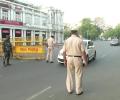
Delhi Police have arrested a gangster, Arjun Prasad, who had been absconding for nearly 14 years in connection with multiple cases of dacoity and robbery across Delhi and Punjab.

The 'rescue' operation occurred within kilometres of Iran's underground tunnel complex at Isfahan, assessed by the IAEA and US intelligence as holding a substantial portion of the country's 60 per cent enriched uranium stockpile. Retired senior US military officers have highlighted that the mission's footprint -- hundreds of special operators, multiple heavy-lift aircraft deep inside Iran -- appears outsized for recovering a single airman. Prem Panicker continues his must read blog on the Iran War.

The core issues to be settled -- access to Hormuz, Israel's aggression in Lebanon, the question of Iran's nuclear programme, sanctions relief and compensation -- are thorny enough to require weeks of patient negotiation. The most likely outcome of the opening sessions is that both sides take the measure of each other, establish what is and is not negotiable, and return home without having broken anything. That would count as progress.

The United States, which entered this war in expectation of a short, sharp win along the Venezuela model, is now preparing for deeper involvement in a conflict it does not fully control, without the allies it typically relies on, against an adversary that is not behaving as expected, in a global environment that is already absorbing economic shock. Prem Panicker continues his must read daily blog on the Gulf War.

The question is no longer whether the war will expand. It has. The next few days will tell us whether the war stabilises around Hormuz or whether the Strait itself becomes the trigger for a far larger rupture. What to watch for over the next 48 hours is simple: Any move by the US toward direct naval control of the Strait; any credible Iranian attempt to disrupt or mine shipping lanes and, critically, whether energy infrastructure in the Gulf continues to be targeted.If those lines are crossed in tandem, the war will no longer be containable within the region.

Fight on toward goals that keep receding, or exit with most objectives unmet. Trump is agitated, his poll numbers falling below the Plimsoll line, his base fractured between those who back the war and those who remember that he campaigned on ending them.

'We should learn from the wild world on how they live harmoniously.'

When everyone has footage and no one can verify it, the loudest voice wins, notes Prem Panicker who begins a daily blog on the War in the Middle East.

Today's situation in the Shaksgam Valley is the consequence of what happened in Gilgit in 1947. But is India ready to militarily get back its territories? asks Claude Arpi.

I am inclined to believe that the Venezuela adventure is not an indication of American strength, alas, but rather of American weakness, points out Rajeev Srinivasan.

Indian private sector and State-run refiners continued to receive crude oil from Russian suppliers even after November 21 -- the winding-down date for US sanctions on supplies from leading Russian oil producers imposed in October -- as new intermediaries sprung up in West Asia to sell the oil, according to senior refining sources and ship tracking data.

India has rejected White House Trade advisor Peter Navarro's comments on New Delhi for its procurement of Russian crude oil, calling them 'inaccurate and misleading'. The relations between New Delhi and Washington are on a downturn after President Donald Trump doubled tariffs on Indian goods.

Trump said California has been particularly "hard hit" because of this, blaming democrat Gavin Newsom, the Governor of California, for this loss, calling him "weak and incompetent."

Former White House trade advisor Peter Navarro accuses India of being an 'oil money laundromat' for Russia, alleging that India's oil purchases are funding Putin's war in Ukraine. The accusations come amid existing trade tensions and tariffs imposed by the US.

Vladimir Putin wants to destroy Ukraine's power plants before the onset of winter in the hope that Ukrainians, unable to cope with the bitter cold, end their determined resistance to the Russian invasion, which will enter its eighth month on Monday, October 24, 2022.

'Putin dreams about his legacy. He wants to forcibly restore the Russian empire.' 'Unfortunately, after three years of large-scale war with massive human losses, Putin will not budge from his goal because human life is the cheapest resource in the Russian State.'

Latest satellite images issued by United States company Maxar revealed that Russian forces are getting ready for a massive offensive in the Ukrainian capital city of Kyiv.
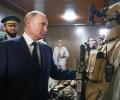
With the fight now having been taken to the seizure of nuclear plants, it is one more warning to Europe that this prolonged war could end up with disastrous consequences, observes Rashme Sehgal

Jaishankar said he was confident that Prime Minister Modi and President Putin will meet for an annual summit next year.

The locusts initially entered Rajasthan from Pakistan and from there the swarms moved towards Madhya Pradesh, Haryana, and Punjab over the last few weeks and are now threatening to enter Uttar Pradesh, putting at risk the summer crop.
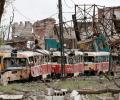
Scenes from the fighting near the Azovstal steel plant in Mariupol.
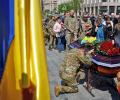
Russia's invasion of Ukraine brought death to thousands of soldiers and civilians while millions of Ukrainians have been displaced. It has brought death, destruction and hardship to the country.

Electricity and heating outages across Ukraine caused by Russian missile and drone strikes to energy infrastructure have added urgency to the Ukrainian preparations for winter.

The military conflict around the Zaporizhzhia nuclear power plant in Ukraine -- Europe's largest nuclear plant -- has raised fears of an accident worse than the Chernobyl accident in 1986.

Zaporizhzhia power plant spokesperson Andrey Tuz said the plant has not sustained any critical damage, although only one power generation unit out of six is operational as the fire continued at the facility.
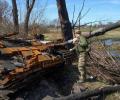
The spokesman said that high-precision Kalibr cruise missiles hit a military facility on the outskirts of Kyiv overnight.

The number of new entrants is decreasing since 2015, as Indian market matures

From the customer point of view too, LFP batteries are safer and offer a longer life.
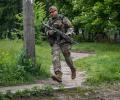
Russian forces had occupied Ruski Tyshky for two months before being pushed back by Ukrainian troops three weeks ago.

Victory in Mariupol would mean a significant achievement for Vladimir Putin's invasion since it would bring one more area in eastern Ukraine under its control.

'If he were to drop even one nuclear weapon on Europe, it would start a nuclear war that would destroy everybody.'

'Certain groups should be more cautious, especially the 60-plus population, and the population which suffer from co-morbidities like diabetes and hypertension.'

'This is still a relatively immature defense and high-tech relationship.'

The communities north of Kyiv were square in the path of Russia's devastating but ultimately unsuccessful attempt to seize the Ukrainian capital.

Farewells and goodbyes. Always said in the hope that we will meet again.

The second wave of the pandemic has not only crippled medical infrastructure in terms of hospital beds, but has also led to bottlenecks in invasive ventilators and medical oxygen capacities and supplies.
